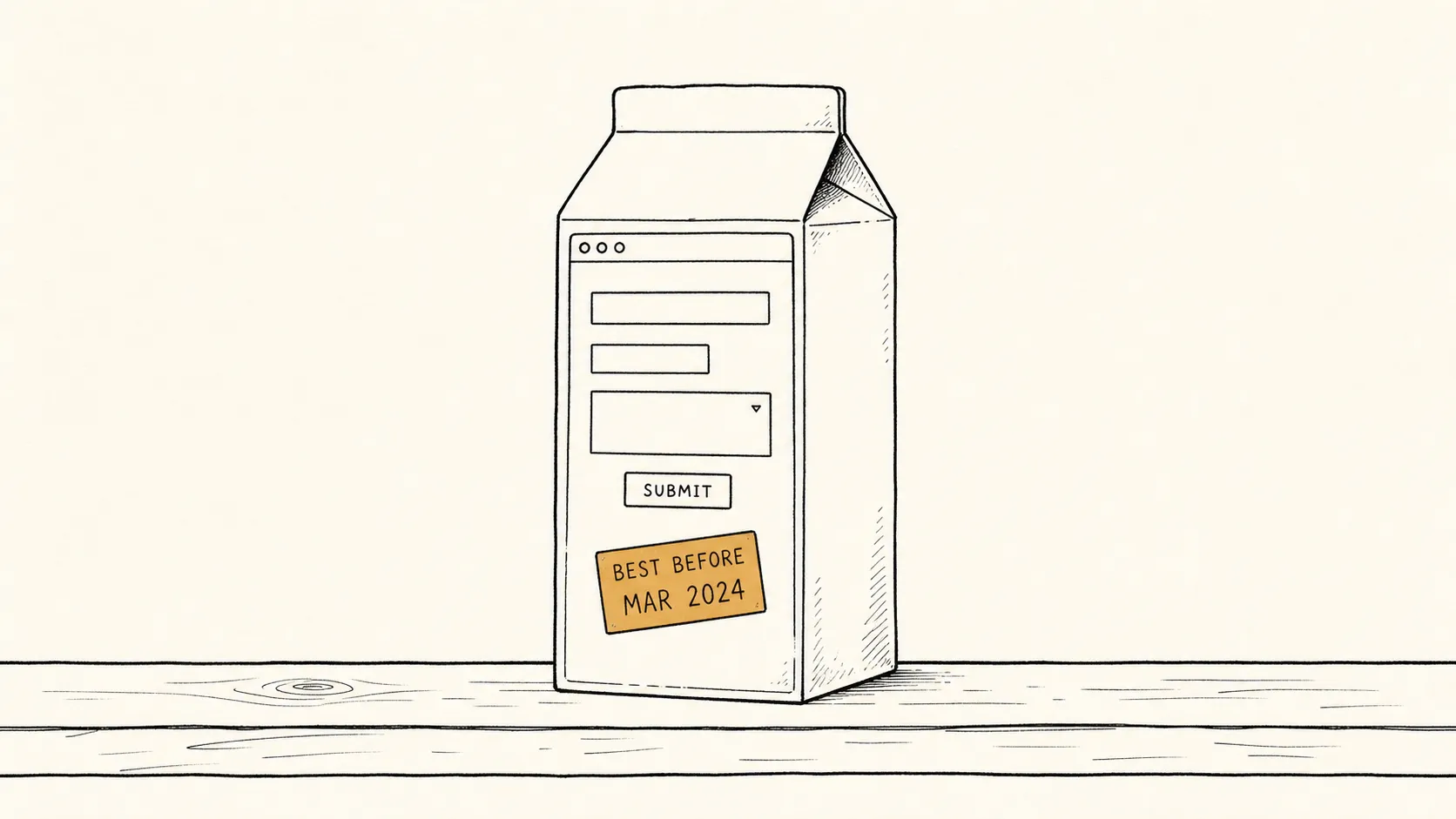
Why most enterprise software training is already out of date — and what changes when it isn’t.
You roll out the new platform in March. Training ships in February: a polished video library, a SCORM package in the LMS, the works. By July, three screens have been redesigned, two workflows are deprecated, and the help desk is fielding the same question every day from users who watched the training and then couldn’t find the buttons.
The training wasn’t wrong on day one. It aged.
This is the shelf-life problem, and it’s the quiet cost center sitting underneath most software rollouts. It rarely shows up as a line item, because the line item — the production budget — already cleared finance. The cost lives somewhere else.
Where the cost actually shows up
It shows up in help desk volume that doesn’t taper the way the rollout plan predicted. It shows up in adoption metrics that plateau when the UI drifts from the videos. It shows up in audit findings that flag references to deprecated processes still sitting in the official training portal. It shows up in SMEs who are quietly answering the same questions in Slack for months because nobody trusts the training portal — half of it is wrong, and nobody knows which half.
It shows up, eventually, in the realization that the polished library you paid five figures for has become a Frankenstein of errata documents, addendum emails, and verbal caveats in kickoff calls. Ignore the part where she clicks the green button — we moved that to the kebab menu in v3.
Nobody set out to build that. The economics forced it.
Why traditional production locks you into the problem
When a polished training module costs five figures and six weeks to produce, you can only afford to re-shoot when something big breaks. Everything smaller — the screen redesign, the new field, the reordered workflow steps — has to be patched verbally, written up in an addendum, or quietly ignored.
Each patch is small. Each patch is rational on its own. Six months in, the library looks like a compliance document with footnotes longer than the original text.
This isn’t an L&D failure. It’s an artifact of the cost structure. When re-cutting one module costs as much as the original module, you don’t re-cut casually. So you don’t re-cut at all, until the gap between the training and the system becomes too embarrassing to leave standing — at which point you commission a full refresh and the cycle starts over.
What changes when re-cuts are cheap
The interesting question isn’t “can we make the original library cheaper?” That fight has been going on for a decade and the gains are marginal. The interesting question is what happens when re-cutting a module is hours, not weeks.
The calculation flips. “Keep the library current” stops being a budget conversation and becomes operational hygiene — closer to keeping a knowledge base accurate than to commissioning new media. A screen redesign in the platform triggers a re-cut, not a Slack thread. A new compliance requirement gets a fresh module the week it lands, not in next year’s training cycle.
A few second-order effects fall out of that.
The library and the system stay in sync, which means the help desk and the training start telling the same story. Adoption metrics stop being dragged down by “I watched the training but the screen looks different.” Audit references stay current because they get refreshed when the underlying process changes, not on a separate review cycle.
Multi-language stops being the expensive add-on it usually is. If you can re-shoot in English in a day, you can re-shoot in seven languages in the same run — the cost of localization is dominated by the cost of production, and once production gets cheap, language coverage stops being the deciding factor it used to be.
And the shape of what training can be expands. Process-level walkthroughs that were too narrow to justify a traditional production budget — how to handle this specific exception in the AP workflow, what changed between v3.4 and v3.5 of the request form — become viable. Training stops being limited to the things big enough to earn a project plan.
Where this matters most
Three contexts where the shelf-life problem dominates, and where shifting the production economics changes the math materially:
Software rollouts where the platform is still moving. Target-state design isn’t frozen, vendor releases are landing, internal configuration is still being adjusted. Traditional production timelines guarantee that the training will be wrong before it ships.
Compliance programs where the regulation just changed. The clock starts the day the rule changes; everything after that is exposure. Production timelines that assume a stable target are misaligned with the reality of regulatory drift.
Post-acquisition integrations. Two companies, two sets of systems, a target-state being built in parallel with the training that has to support it. The integration plan changes monthly; the training has to change with it.
If you’re in one of these contexts and the training doesn’t have a way to keep pace, the gap doesn’t stay constant. It widens, and the widening is the cost.
A simple test
If your current training has an errata document — somewhere, a maintained list of what’s changed since the video was made — that’s the shelf-life problem manifesting. If your SMEs are re-answering the same questions in Slack months after the rollout, that’s the shelf-life problem manifesting. If your adoption curve plateaus around the time the UI drifts from the videos, same thing.
The next refresh cycle is the obvious place to spend money. The non-obvious place is to ask whether the production model itself is the constraint — before sinking another budget into a library that will start aging the day it ships.
Seismic produces software training libraries built to be re-cut as the system changes. If the shelf-life problem is the one you’re solving, start a conversation.